
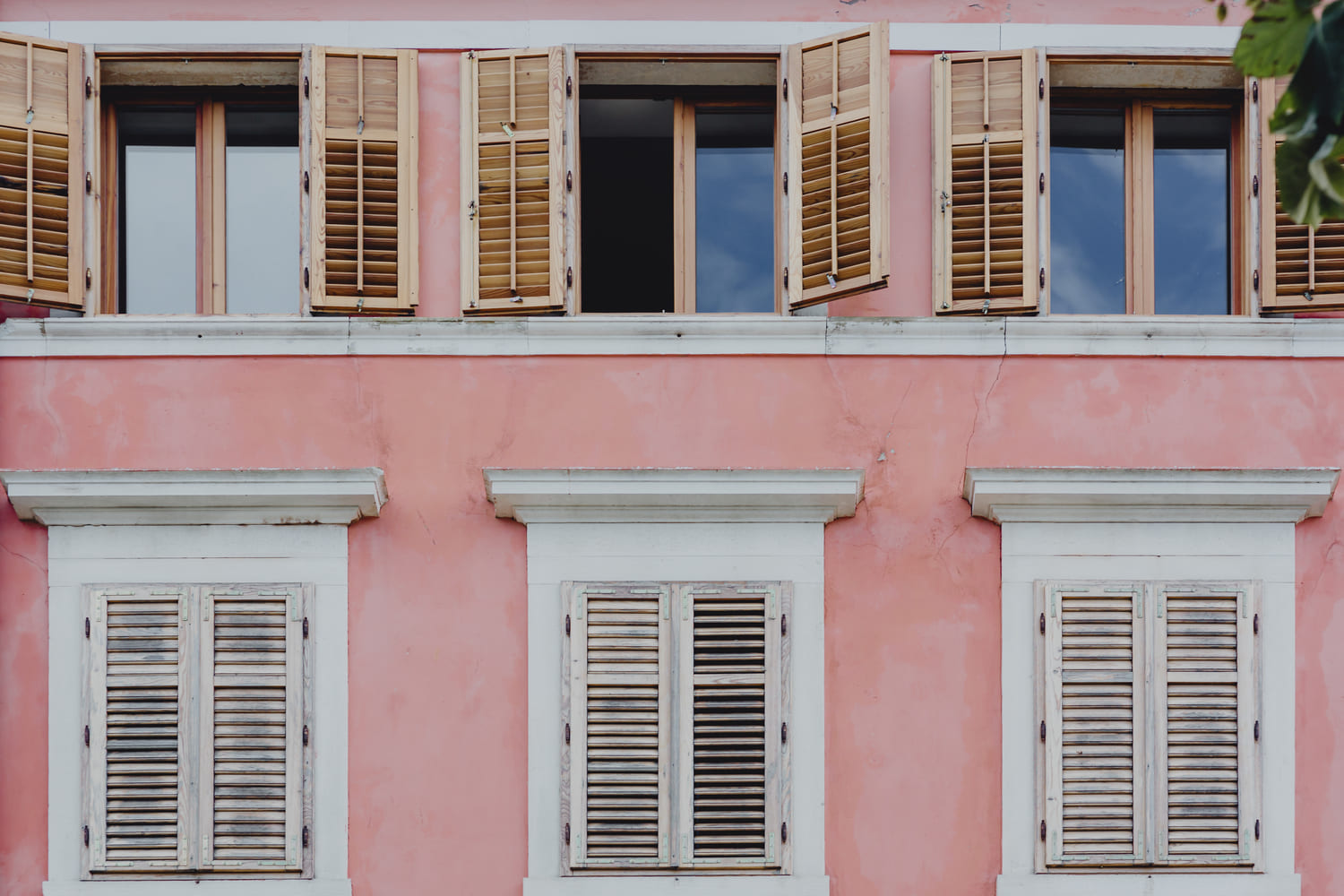
“With new windows you’ll save 50 % on your bill.” You’ve probably read claims like that. We prefer to get the calculator out. We took a very typical Alicante flat, built in the 1970s, and worked out what really changes when its windows are replaced: euros, temperature and noise.
Important note: this is a simulation based on technical reference values, not measurements from a specific home. We share all our assumptions so you can check them and adapt them to your own case.
With windows like these, the frame and glass together have a thermal transmittance (Uw) of around 5.7 W/m²K. In plain terms: every square metre of window lets heat escape almost as if it were a hole with a thin sheet in front of it. And old sliding windows add another problem: the gaps.
For this flat we proposed multi-chamber PVC windows with double glazing: low-emissivity glass with solar control on the outside, an argon-filled cavity and a warm-edge spacer. On the façade facing the avenue, acoustic laminated glass.
The result is a Uw of around 1.3 W/m²K, four times lower than the original window. We also replaced the sliding windows with casement and tilt-and-turn windows, which close tightly against the seals and almost eliminate air leakage.
Why solar control? Because in Alicante the big expense isn’t only in winter. Single glazing lets through around 85 % of the sun’s energy; solar control glass can keep that below 45 %. In summer, you notice it in the air conditioning.
Adding up the losses through the glass and frame, air leakage and solar gain in summer, this is our estimate:
It may seem little compared with what some adverts promise, and that is exactly what we want you to see. With a heat pump, which is very efficient, the savings in euros are more modest. If your home is heated with electric radiators or butane heaters, the savings can be three times higher, because every kWh of heat lost costs considerably more.
This is the difference you notice most in everyday life. Picture a January night with 5 °C outside and 20 °C in the living room:
And since the glass no longer drops below the dew point, the morning condensation is gone too.
An old aluminium sliding window with single glazing usually insulates around 20-25 dB, mainly because of the gaps. A casement window with acoustic laminated glass can reach 36-40 dB.
Every 10 dB of difference is perceived roughly as halving the noise. In practice, the traffic on the avenue goes from “too loud to watch TV” to a background murmur.
If you only look at the bill, the payback period can be long. But replacing your windows also brings thermal comfort, less noise, an end to condensation and more security. It can also increase the value of your home and improve its energy certificate.
Remember that in Spain this type of work may qualify for personal income tax (IRPF) deductions for energy efficiency improvements, provided it is supported by energy certificates issued before and after. Check the current requirements before you start.
Every home is different: orientation, floor, heating system, habits. If you’d like to know what the numbers would be in your case, at Replus we carry out the technical visit and give you an honest estimate, with no advertising promises.